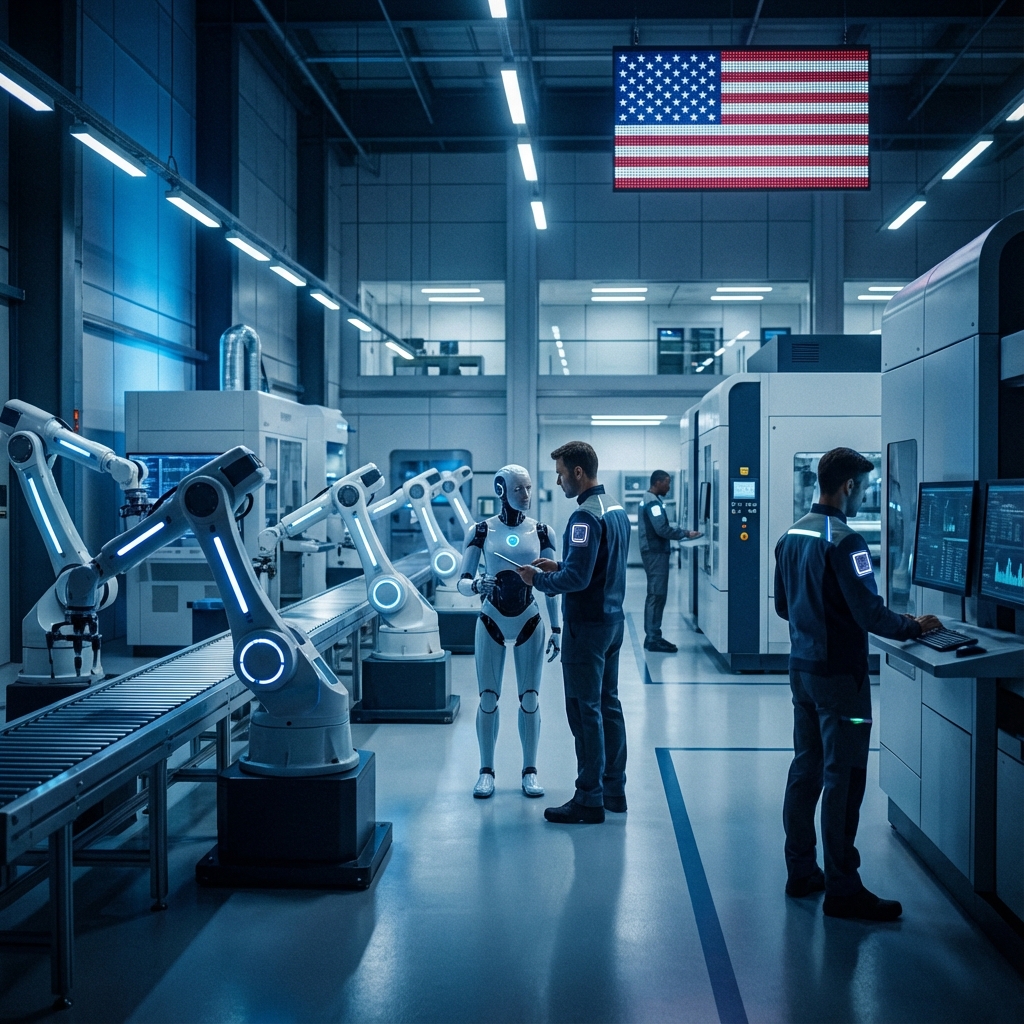
BUILT TO LAST
Applying complex efforts by governments and private companies to boost domestic production. Innovation meets resilience.
Applying complex efforts by governments and private companies to boost domestic production. Innovation meets resilience.
It's a strategic imperative involving economic stability, national security, and future resilience.
Boosts U.S. jobs and reduces trade deficits. Manufacturing currently contributes $2.9 Trillion annually to the economy.
Reduces reliance on foreign adversaries for critical goods like semiconductors, pharmaceuticals, and defense components.
Creates robust supply chains less vulnerable to global disruptions, pandemics, or geopolitical instability.
A "carrot and stick" approach. Administrations have used tax incentives (carrots) for domestic production while imposing tariffs (sticks) on imports to level the playing field.
Major players are stepping up. Companies like Apple have announced billions in investments for U.S. manufacturing and workforce training.
A conscious shift. Consumers are actively supporting brands like New Balance, Green Toys, and City Threads.
U.S. wages are significantly higher, creating a price gap that makes domestic goods more expensive to produce.
A shortage of skilled labor and an aging workforce present difficulties in filling high-tech manufacturing roles.
Rebuilding missing domestic supplier networks and complying with stricter local regulations add complexity.
Overseas manufacturing hubs have spent decades optimizing for speed and low cost, creating stiff competition.

While some progress is seen in specific areas like defense and tech, a complete return to peak manufacturing employment is complex. The U.S. economy is heavily driven by service industries—a sector often overlooked in manufacturing-focused policies.
However, every step towards reshoring strengthens our middle class and revitalizes local communities.
"We are not just building factories; we are rebuilding trust in the American promise."
The Tariff Strategy
A polarizing approach to reshoring.
Of all the illogical, wildly incoherent and downright bizarre aspects of the tariff war, there is perhaps nothing more inexplicable than the fixation on restoring and reshoring American manufacturing. It’s hard to think of a worse idea than creating vast economic dislocation to make America a global manufacturing hub.
It’s a goal that is not only unachievable; it’s a terrible idea that ignores America’s key comparative advantage as a provider of global services. To listen to the discourse about tariffs and trade is to hear a message on manufacturing that would have made more sense in the 1970s or 1980s.
"We need to reshore manufacturing." — U.S. Trade Representative Jamieson Greer.
No, we don’t.
Let’s start with some basic data. Manufacturing is a mere 10% of the U.S. GDP and has been steadily declining for years. By comparison, health care is 17.5%, real estate is around 14%, and professional services account for around 13%.
Service industries—financial, legal, health care, education, IT, media—make up 70 percent of the U.S. economy. In 2022, services represented 30% of all U.S. exports. Yet, this crucial element has gone largely unmentioned in the tariff war. It seems almost embarrassing to talk about the fact that America has a nearly $280 billion trade surplus in services.
Bringing back American manufacturing by raising tariffs will not make goods cheaper. Instead, because of labor costs alone, goods manufactured again in America would become significantly more expensive. One estimate suggests creating an iPhone in the U.S. would run the price up to $3,500.
Notably, the manufacturing sector wasn't decimated in recent years. Nearly 800,000 new manufacturing jobs were created recently, largely in high-tech sectors like semiconductors, battery storage, and clean technology—driven by legislation like the CHIPS and Science Act. These industries look very different from the "belching smokestacks" of yesteryear; they are innovative, automated, and efficient.
The Bottom Line
"The worst part of the tariff strategy is its incoherence and the acute financial uncertainty it has created."